
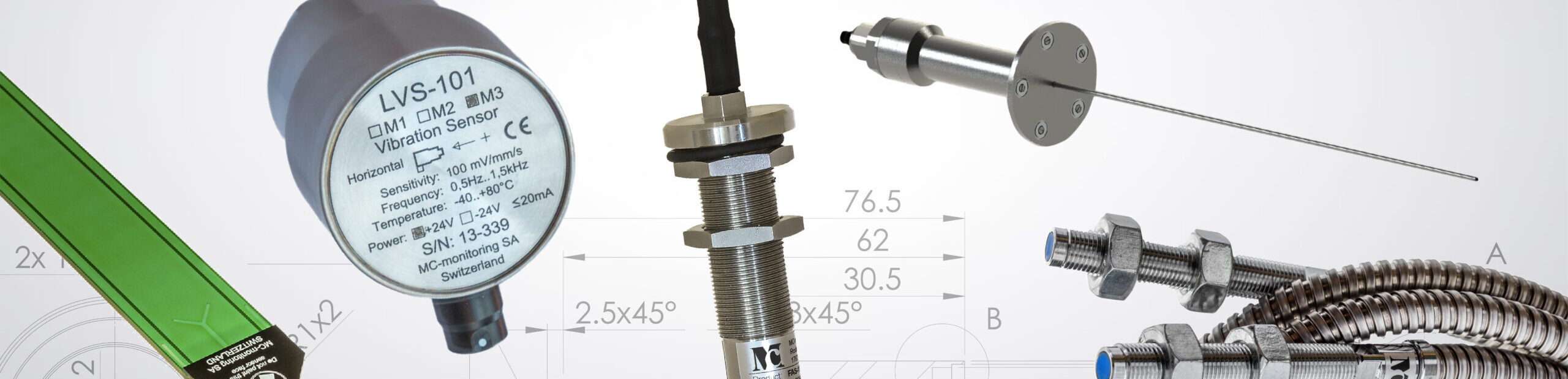
PROXIMITY PROBES

Proximity probes are non-contact eddy-current sensors used to measure shaft vibration and axial thrust position in rotating machinery. These sensors are widely used in turbines, hydrogenerators, compressors, pumps, and large electric motors where precise monitoring of shaft displacement is critical for machine protection and condition monitoring.
By continuously measuring shaft movement relative to the bearing, proximity probes enable early detection of mechanical issues such as imbalance, misalignment, shaft eccentricity, and thrust bearing wear. This allows operators to implement predictive maintenance strategies, reduce unplanned downtime, and improve the reliability and lifetime of critical rotating assets.
MC-monitoring offers two complementary proximity measurement solutions designed to meet different monitoring architectures and installation requirements:
- Smart Proximity System (SPS) – modular proximity probe system for advanced monitoring and machinery protection
- Integrated Proximity Probe (PPT-280) – compact all-in-one probe for simplified installation
Together, these solutions provide flexible monitoring options ranging from advanced digital condition monitoring systems to API 670 compliant machinery protection systems.
Smart Proximity System (SPS)
The Smart Proximity System (SPS) is a modular eddy-current measurement system designed for shaft vibration and axial position monitoring in rotating machinery.
The system consists of a proximity probe, extension cable, and signal conditioning electronics. Depending on the application, the SPS can be equipped with either:
- a Digital Proximity Transmitter (DPT-100) for condition monitoring or direct connexion to PLC, DCS or SCADA systems
- an Analog Proximity Driver (PSD-200) for machinery protection systems API 670 compliant
Key Benefits:
- Available with digital transmitter or analog driver electronics
- Interchangeable and highly configurable components (probe, extension cable, and electronics) simplify system adaptation, maintenance, and spare parts management
SPS Key Features:
- Linear measurement ranges: 2 and 4 mm
- (+/-) 8mV/μm or (+/-) 4mV/μm sensitivity output
- Optional 4–20 mA output with Modbus (DPT-100)
- Temperature range (sensor & cable): −35 to +180 °C
- 5m, 10m or 15m total length systems
- API 670 5th ed. compliant
- Self-diagnostic with status led

Components of a Smart Proximity System
The SPS is a modular system composed of three key elements:
- The Proximity System Probe (PSP) is a high-performance eddy-current sensor designed for precise, non-contact measurements in rough industrial environments. Its robust construction and thermal stability ensure reliable operation over time.
- The Proximity Sytem Extension cable (PSE) is an industrial-grade coaxial cable that allows easy disconnection near the measurement point, simplifying installation and maintenance operations. Designed for robust industrial use, it provides mechanical flexibility and ensures secure, high-integrity signal transmission.
- The SPS signal conditioning electronics power the probe and convert the measured signal into usable outputs for monitoring or protection systems. Two electronics options are available:
The DPT-100 Digital Proximity Transmitter is designed for condition monitoring and system integration, providing Modbus RTU communication, an optional 4–20 mA processed output, and calculated values such as min gap, max gap, mean gap, pk-pk for seamless integration into SCADA, PLC, and monitoring platforms.
The PSD-200 Analog Driver is designed for machinery protection systems compliant with API 670, delivering a high-bandwidth dynamic signal and supporting integration into turbine protection systems and demanding industrial applications.
All system elements are fully interchangeable, enabling quick on-site servicing and reducing downtime without compromising performance or signal integrity.
Signal Outputs
The Smart Proximity System provides several signal outputs depending on the selected electronics configuration.
The dynamic voltage output is available on both the DPT-100 and PSD-200, delivering a raw signal of 8 mV/µm or 4 mV/µm for vibration analysis, commissioning, and machinery protection systems.
With the DPT-100, additional outputs are available, including a Modbus RTU digital interface providing calculated values, as well as an optional 4–20 mA processed output for direct integration into PLC and control systems.
This combination of raw and processed signals allows the SPS to support both advanced diagnostics and continuous machine protection, across modern and legacy system architectures.
Integrated Proximity Probe (PPT-280)
The PPT-280 is a compact, all-in-one proximity probe designed for fast, straightforward installation without the need for external signal conditioners. The probe is designed with integrated linearization electronics to ensure excellent linearity and active temperature compensation. The integrated 750 kHz oscillator ensures a measurement with minimal magnetic run out effect. It integrates the eddy-current into a single, sealed body—delivering a direct voltage output proportional to the shaft’s position.
An optional configuration kit allows users to adjust the measuring range, power supply voltage, and perform on-site calibration, making the PPT-280 a flexible and efficient solution for standard vibration or axial position monitoring.
Key Benefits:
- One-component installation simplifies wiring and saves space—no external driver required
- Configurable setup using a field-adjustable kit (optional) for range and polarity tuning
PPT-280 Key Features:
- Measurement ranges: 2mm (8mV/μm) and 4mm (4mV/μm)
- Frequency range : 0 to 1.2kHz
- Built-in linearization electronic & active temperature compensation
- Supplied with -24V or +24V depending on the configuration
- Optional : configuration kit and digital interface for setting and calibration
- 10m length
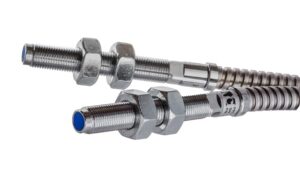
The PPT-280 is ideal for users seeking a compact, self-contained proximity probe that minimizes installation effort and component count.
Advanced analysis with CMS-500P
Monitoring both vibration and position is critical for understanding the real health of rotating equipment. The CMS-500P provides the tools to turn this data into actionable insights for long-term performance and reliability.
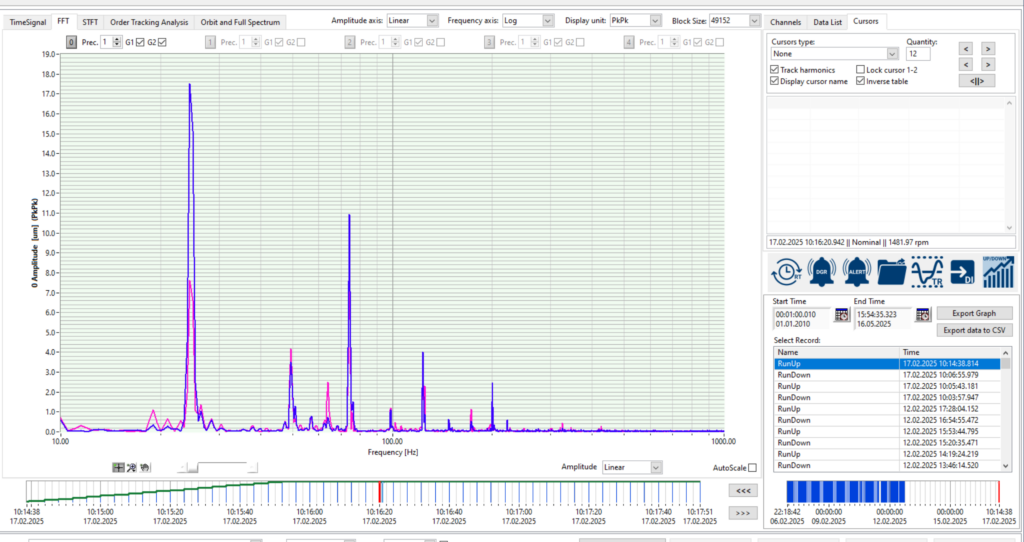
FFT – Frequency-Based Vibration Analysis
The Fast Fourier Transform converts the raw vibration signal into its frequency components, revealing mechanical faults like resonance, unbalance, or misalignment. It’s essential for in-depth diagnostics and root cause analysis.
Orbit Plot – Shaft Vibration in the Radial Plane (X-Y)
Orbit plots visualize the shaft's real-time motion in the horizontal plane using two orthogonal proximity probes. This view is key to identifying unbalance, rubs, fluid film instabilities, or looseness — especially during startup, shutdown, or transients.

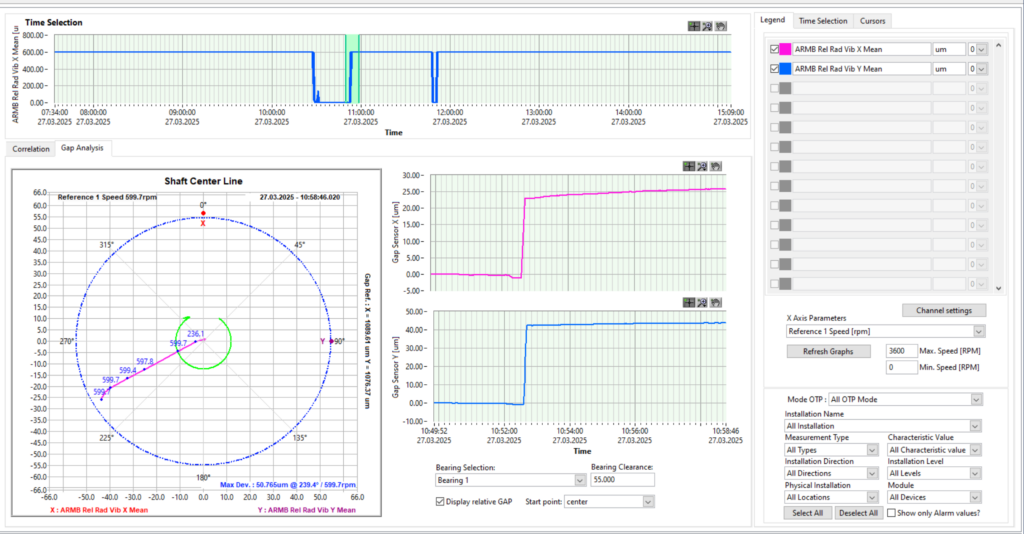
Shaft Center Line – Radial Shaft Position Over Time (X-Y Plane)
The Shaft Center Line plot shows the average position of the shaft within the bearing clearance, based on two orthogonal proximity probes. It reveals how the shaft moves or drifts over time due to load changes, thermal effects, misalignment, or oil film behavior.
This view is particularly valuable in vertical machines, where oil film conditions and dynamic loads can cause subtle radial shifts. By tracking these trends, operators can detect evolving mechanical issues and indirectly assess the performance of the bearing lubrication system.
Monitoring solutions


Available models
SPS
- Measuring range 0.2mm to 2.2mm or 0.2mm to 4.2mm
- Sensitivity 8mV/µm or 4mV/µm
- Modbus interface
PPT-280
- Measuring range 0.2mm to 2.2mm or 0.2mm to 4.2mm
- Sensitivity 8mV/µm or 4mV/µm
- 10m integral cable
PPT-990 configuration kit
- Configuration kit for PPT-280
Downloads
OTHER SENSORS

AIRGAP
TRANSDUCERS

MAGNETIC FIELD
TRANSDUCERS

PROXIMITY
PROBES

PARTIAL DISCHARGE
COUPLER

LINEARIZE VELOCITY
SENSORS

RUNNER CLEARANCE
PROBES
LET'S KEEP IN TOUCH
Sign up to receive our newsletters