
HOUSING EXPANSION PROBE
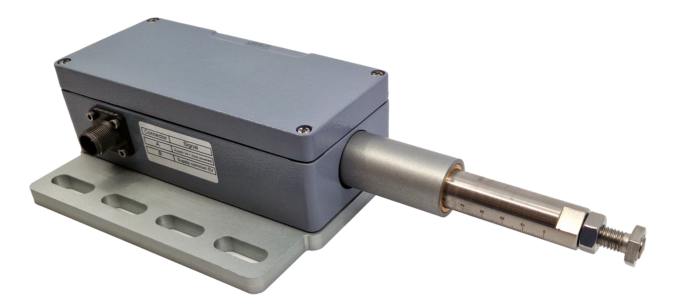
The HEP-100 housing expansion probe from MC-monitoring is a linear inductive displacement sensor engineered to measure the thermal growth of machine casings during start-up, load changes, and steady-state operation. Designed for direct integration with PLC, DCS and SCADA systems through its integrated 4–20 mA transmitter, the HEP-100 enables operators of gas and steam turbines to reliably monitor housing expansion, protect critical assets, and support data-driven maintenance decisions.
Key features
- Linear inductive measurement principle: Robust displacement measurement immune to dust, oil mist and harsh industrial conditions.
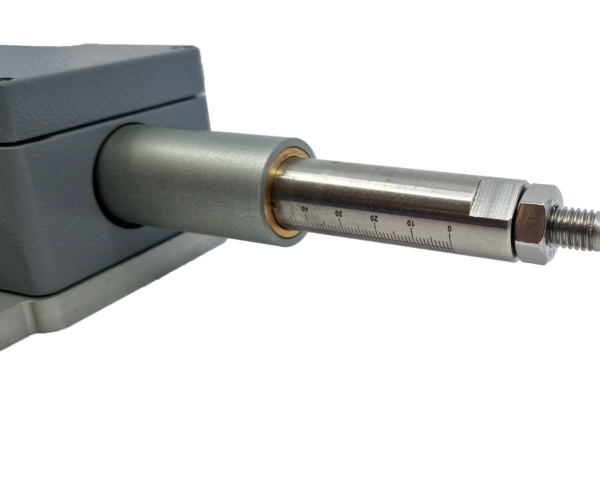
- Measuring range up to 50 mm (±25 mm): Suitable for a wide range of turbine and machine casing sizes.
- Integrated 4–20 mA output: Direct connection to PLC, DCS or SCADA systems with no additional signal conditioner required.
- Configurable measuring direction: Selectable increasing or decreasing output to match plant convention and machine layout.
- High accuracy and long-term stability: Accuracy better than 0.5% and temperature drift below 0.01% / °C.
- Industrial-grade robustness: Stainless steel outer tube and measuring rod, withstanding high shock and vibration levels.
- IP66 protection rating: Reliable performance in demanding industrial environments.
- Wide operating temperature range: Continuous operation from −20 °C to +85 °C.
- Simple installation: Compact housing with integrated electronics and slotted mounting plate for easy on-site alignment.
Description
Housing expansion — also known as casing expansion or shell expansion — is a key supervisory parameter on heavy-duty gas and steam turbines. As the machine heats up during start-up and loading, the casing expands axially relative to its fixed support. Monitoring this thermal growth is essential to confirm normal operating behaviour, prevent rubbing between rotor and stator, and protect the machine from mechanical damage caused by thermal mismatch.
The HEP-100 is a linear inductive displacement sensor specifically developed for this application. It uses an internal movable core inside a coil to convert the axial position of the measuring rod into an electrical signal proportional to displacement. This inductive measurement principle delivers excellent long-term stability, high immunity to electromagnetic disturbances, and reliable operation in environments where optical or capacitive sensors would be limited.
The sensor is supplied with integrated electronics and an industry-standard 4–20 mA current output, allowing direct connection to PLC, DCS or SCADA systems without additional signal conditioning. Its compact, robust enclosure and slotted mounting base make it easy to install on turbine baseplates and bearing pedestals, where it operates as part of a complete turbine supervisory instrumentation package alongside shaft vibration, bearing vibration and axial thrust position measurements.
Monitoring solutions

Casing expansion
Applications

Downloads
OTHER SENSORS

MAGNETIC FIELD
TRANSDUCERS

PROXIMITY
PROBES

PIEZOELECTRIC
SENSORS

PARTIAL DISCHARGE
COUPLER

LINEARIZED VELOCITY
SENSORS

RUNNER CLEARANCE
PROBES
LET'S KEEP IN TOUCH
Sign up to receive our newsletters