

Success Story: Modbus TCP to RTU Gateway
During the commissioning of a large rotary energy conversion unit, a new modular protection system had to be integrated into an existing plant control architecture. The upgrade involved replacing a legacy monitoring system with our modern Ethernet-based Protection & Monitoring System PMS-300P, while preserving the original control system interface.
The constraint was non-negotiable: the existing DCS communicated exclusively via Modbus RTU over RS-232, using a fixed register structure and predefined slave IDs. No modification of the control logic or communication parameters was allowed.
At the same time, the new PMS-300P operates natively on Modbus TCP/IP over Ethernet, delivering vibration values, alarm states, and status signals via network communication.
From an engineering perspective, the objective was clear:
Integrate modern Modbus TCP devices into a legacy Modbus RTU environment, without impacting the control system.
Integration Strategy
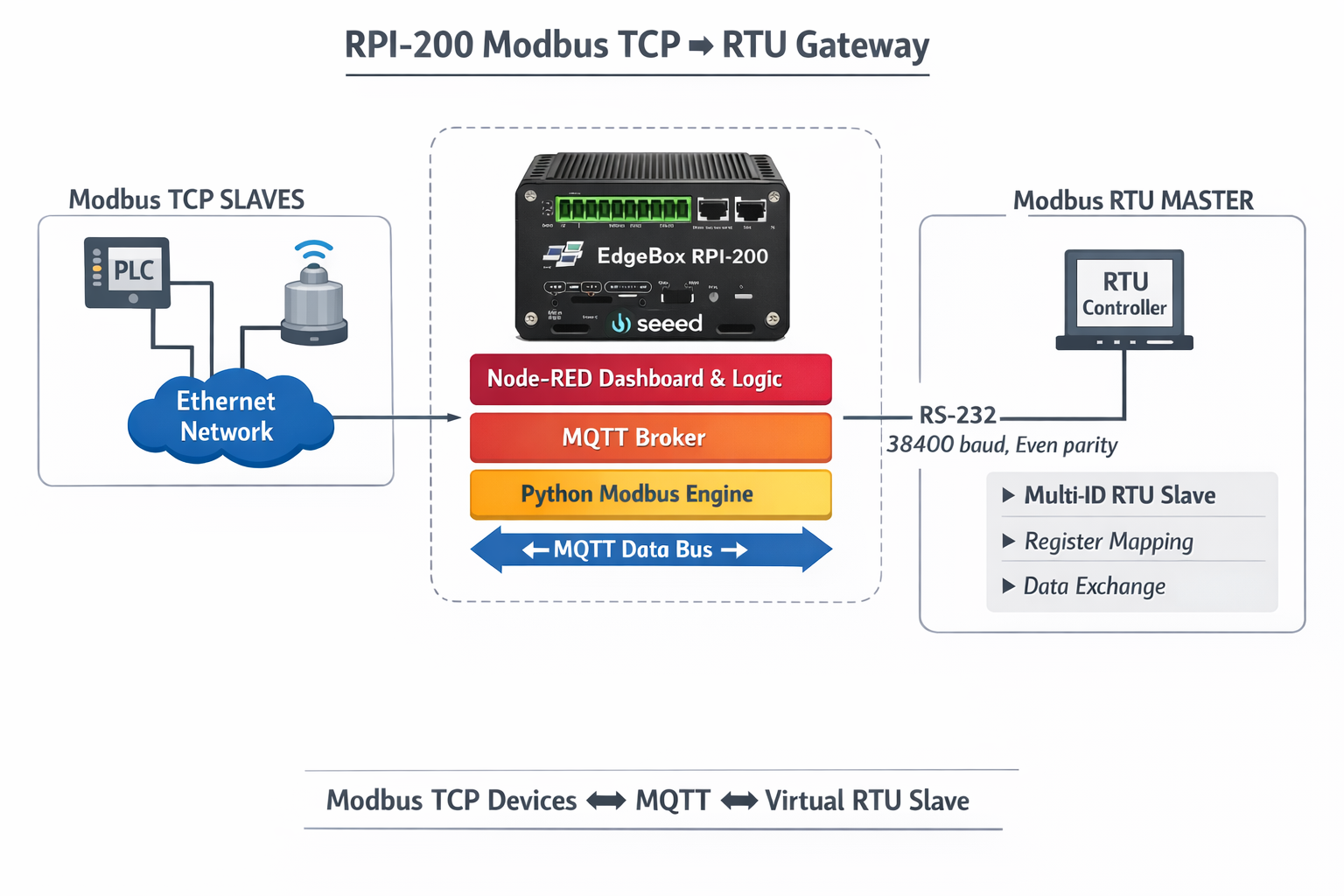
To bridge the two communication layers, an industrial EdgeBox RPI-200 was deployed as a Modbus TCP to Modbus RTU gateway.
On the Ethernet side, the gateway polls multiple Modbus TCP devices, including the new protection modules. On the serial side, it presents itself to the DCS as a standard Modbus RTU slave operating at 38400 baud with the required parity and timing configuration.
From the DCS perspective, nothing changed. The same slave IDs, the same register addresses, and the same polling logic remained in place.
Internally, however, the architecture was completely modernized.

Gateway Architecture and Data Handling
The gateway acts as a structured translation layer between two communication environments.
A Python-based Modbus engine manages TCP polling and RTU response handling. Node-RED is used for register mapping and routing logic, while an internal MQTT data bus ensures clean separation between acquisition, processing, and serial response layers.
The gateway aggregates data from multiple TCP devices, converts floating-point values into the expected RTU format, maps alarms and status words to predefined register blocks, and ensures deterministic response behavior toward the RTU master.
In practice, several Ethernet devices can be consolidated into a single virtual RTU slave image. Multi-ID configurations can also be emulated when required.
Particular attention was given to serial timing and response behavior to guarantee compatibility with the existing master polling cycle.
Field Results
From a commissioning standpoint, the integration was fully transparent for the control system:
The DCS required no modification.
The RTU register structure remained identical.
Polling behavior and response times remained stable.
At the same time, the protection platform benefits from Ethernet-based communication, higher acquisition bandwidth, improved diagnostic capabilities, and future expansion flexibility.
The implemented architecture also enables the possibility to connect a condition monitoring system such as CMS-500 PLUS, allowing advanced data recording, long-term trending, and detailed vibration analysis without impacting the legacy control interface.
The gateway effectively decouples the modern protection architecture from the legacy control layer. The plant can now expand its Ethernet-based monitoring infrastructure without impacting the serial DCS interface.
Practical Takeaway
For brownfield installations, replacing a control system is often the highest-risk part of a modernization project. By introducing a properly engineered Modbus TCP to RTU gateway, it is possible to upgrade protection and monitoring systems while preserving the existing automation backbone.
This project demonstrates a practical and robust integration approach combining modern internal architecture with a legacy external interface, ensuring stable, transparent, and scalable operation.
LET'S KEEP IN TOUCH
Sign up to receive our newsletters