


Multi-Modal Monitoring for Accurate Machine Diagnostics
Modern rotating machines operate under complex interactions between mechanical, electrical, and thermal phenomena. Monitoring only one parameter, such as vibration, provides valuable information, but it rarely tells the complete story.
To truly understand machine behaviour and detect faults early, operators increasingly rely on multi-modal monitoring, where multiple sensing technologies are integrated within a unified monitoring architecture.
At MC-monitoring, we design integrated monitoring solutions combining multiple sensing technologies to enable this correlated approach to machine diagnostics.
Why Multi-Modal Monitoring Matters
Traditional condition monitoring often focuses on one dominant measurement, typically vibration. While vibration analysis remains essential, many failure modes in large rotating machines involve interactions between different physical phenomena.
Examples include:
- Electrical faults influencing mechanical vibration
- Rotor eccentricity affecting air gap and magnetic field distribution
- Thermal stresses modifying mechanical alignment
- Process load variations impacting dynamic behaviour
Without correlated data, engineers are often left interpreting symptoms rather than identifying the true root cause.
Multi-modal monitoring solves this problem by capturing multiple parameters simultaneously and analysing them together.
Key Monitoring Technologies Working Together
In a multi-modal monitoring architecture, several sensing technologies contribute complementary insights.
Vibration Monitoring
Vibration measurements reveal mechanical behaviour of rotating components and allow detection of issues such as:
- Rotor imbalance
- Shaft misalignment
- Bearing degradation
- Structural resonance
Vibration often provides the first indication that something abnormal is occurring, but it does not always explain why.
Air Gap Monitoring
Air gap measurements track the distance between rotor and stator, providing critical information about machine geometry and magnetic forces.
This technology helps identify:
- Rotor eccentricity
- Mechanical deformation
- Magnetic pull imbalances
Air gap variations are particularly important in large hydro-generators and gearless machines.
Magnetic Flux Monitoring
Magnetic flux monitoring provides insight into the electromagnetic condition of the generator rotor.
It can detect faults such as:
- Shorted rotor turns
- Pole-to-pole asymmetry
- Electrical imbalance
These electrical faults often manifest mechanically through vibration or thermal effects, making flux monitoring a critical complement to mechanical measurements.
Temperature Monitoring
Temperature sensors reveal thermal stress and cooling efficiency within the machine.
Thermal anomalies can indicate:
- Insulation deterioration
- Electrical losses
- Cooling circuit problems
- Localized overheating of rotor poles or stator windings
Temperature data often confirms the severity and progression of developing faults.
Process Parameters
Operational data such as load, speed, or hydraulic conditions provide the context needed to interpret machine behaviour.
Process parameters allow engineers to determine whether a vibration change is caused by:
- Normal operating conditions
- Mechanical deterioration
- Electrical imbalance
- Process-driven disturbances
Correlated Diagnostics in Practice
Consider the following scenario:
An operator observes a rising 2X vibration amplitude on a large generator.
With vibration monitoring alone, several explanations could be possible:
- Shaft misalignment
- Thermal rotor bow
- Electromagnetic forces
Further investigation would typically require additional inspections or shutdown planning.
With multi-modal monitoring, the diagnosis becomes significantly clearer.
Magnetic flux monitoring reveals flux asymmetry on specific rotor poles, while temperature sensors detect a localized temperature increase in the same region.
Together, these independent measurements converge toward a single root cause: A developing shorted rotor turn.
Instead of scheduling exploratory inspections, maintenance teams can immediately plan a targeted intervention, reducing diagnostic time from weeks to hours.
The Role of Integrated Monitoring Platforms
To fully benefit from multi-modal monitoring, all measurements must be:
- Acquired simultaneously
- Time-synchronized
- Analyzed within a unified platform
Modern monitoring systems combine sensors, acquisition units, and advanced analytics software to transform raw measurements into actionable diagnostics.
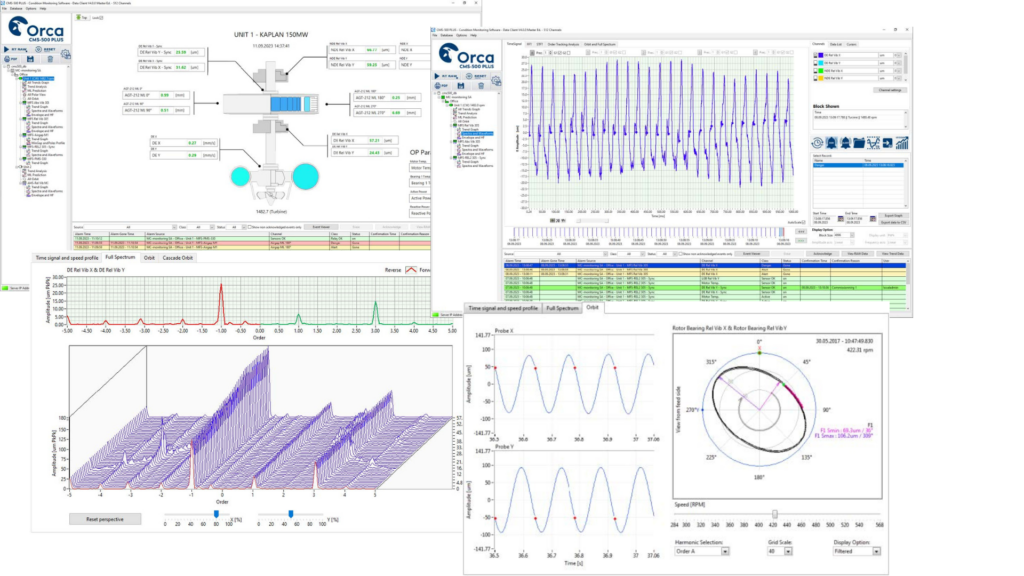
MC-monitoring solutions integrate these technologies through advanced acquisition platforms and the CMS-500P condition monitoring software, enabling engineers to visualize trends, analyze dynamic signals, and correlate multiple machine parameters within a single environment.
This architecture allows operators to move from isolated signal interpretation toward true machine diagnostics.
From Data to Insight
The real value of multi-modal monitoring lies in its ability to transform isolated signals into clear, correlated machine insights.
Benefits include:
- Faster root cause identification
- Earlier detection of complex faults
- Reduced diagnostic uncertainty
- More targeted maintenance actions
- Improved machine availability
For critical rotating machinery such as hydro-generators, turbo-generators, and large industrial drives, this approach significantly enhances predictive maintenance strategies and operational reliability.
Conclusion
As rotating machines become larger, more complex, and more heavily utilized, relying on a single measurement technology is no longer sufficient.
Multi-modal monitoring represents the next evolution in condition monitoring — enabling engineers to correlate mechanical, electrical, and thermal behaviours to obtain a complete and reliable picture of machine health.
By integrating multiple sensing technologies within a unified monitoring platform, operators gain the diagnostic clarity required to make faster, smarter maintenance decisions.
LET'S KEEP IN TOUCH
Sign up to receive our newsletters